
Ceramic coating
Is ceramic coating worth it in Minnesota?
Short answer: for a car you plan to keep more than three years, yes, and the salt is the reason. Here is what a coating actually does in a Duluth winter, what it costs, and who should skip it.
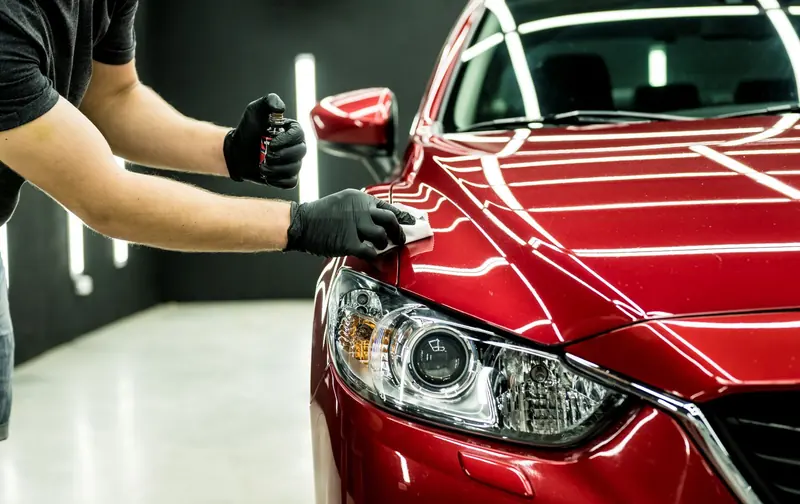
Ceramic coating has been sold hard enough that a lot of people assume it is a gimmick, and sold vaguely enough that most of the people who have one are not sure what it does. We install a lot of them. This is the straight version, for the way cars live here.
What a ceramic coating is
A liquid, mostly silica-based, applied by hand to the paint, that cures into a hard, transparent layer bonded to the clear coat. Think of it as a sacrificial skin a few microns thick that is harder, slicker and more chemical-resistant than the clear coat under it. Wax sits on the paint and washes off in weeks; a sealant is a synthetic wax that lasts months; a coating is bonded, and a good one lasts years.
What it does in a Minnesota winter
- Salt and brine rinse off instead of sticking. The coating is hydrophobic: water beads and runs, and it takes the brine film with it. A coated car after a highway drive in January is visibly cleaner than an uncoated one next to it, and a hose takes the rest off.
- Fewer washes do more. Because dirt does not bond to the slick surface, a touchless wash gets a coated car clean. On an uncoated car, the same wash leaves a film.
- The clear coat is protected from etching. Bird droppings, tree sap, bug guts and water spots etch into clear coat if they sit in the sun. On a coating they sit on the coating, and most wipe off.
- UV fade slows down. Coatings block some UV; red and black paint in particular holds its depth longer.
What it does not do
- It does not stop rock chips or scratches. It is microns thick. A rock on I-35 goes through it like it was not there, and a key does too. Chip and scratch protection is paint protection film, a different product.
- It does not mean you never wash the car. It means washing is easier and less frequent. Brine left on any surface for a month is still brine.
- It does not fix the paint. It seals whatever is under it, which is why every coating starts with paint correction. Coat a swirled car and you have a glossy, swirled car for five years.
What it costs
Our packages start at $750 for three years of protection with paint correction, $1,200 for five years with a one-step correction, and $1,600 for eight years with a two-step. The spread is mostly the correction work and the coating grade. Compare that with a wax every three months or a sealant twice a year, each of which is a visit, and with what a five-year-old car with faded, etched paint is worth against one that still looks new. The packages.
Who should get one
- Anyone with a new or nearly new car they intend to keep. The best time is before the first winter, while the paint is perfect and the correction is light.
- Owners of dark-coloured cars, which show every swirl and every etch mark.
- People who hate washing the car and will do it half as often if it works twice as well.
- Boat owners: gel coat oxidises badly in the sun, and a coating is the best defense there is.
Who should skip it
- Anyone planning to sell the car within a year or two. A sealant and a good detail before the sale is the better spend.
- A car with failing clear coat. Nothing bonds to peeling paint.
- Anyone who will take a coated car through brush car washes every week. The brushes will scratch the coating like they scratch paint, and the money is wasted.
How to decide
Have the paint assessed. We do it free, at your home or work, in half an hour: a diagram of the defects, a score for the paint, and a recommendation that might be a two-step and Platinum, might be a one-step and Gold, and might be "a sealant is all this car needs." You keep the report either way. Schedule a free paint assessment.
Can I wash a coated car at a car wash?
Touchless, yes, and it works well. Brush washes, no; they scratch the coating. Hand washing with a pH-neutral soap is best.
Does the coating need maintenance?
A proper wash every few weeks, no abrasive polishes, and ideally a yearly maintenance wash with a coating top-up. That is it.